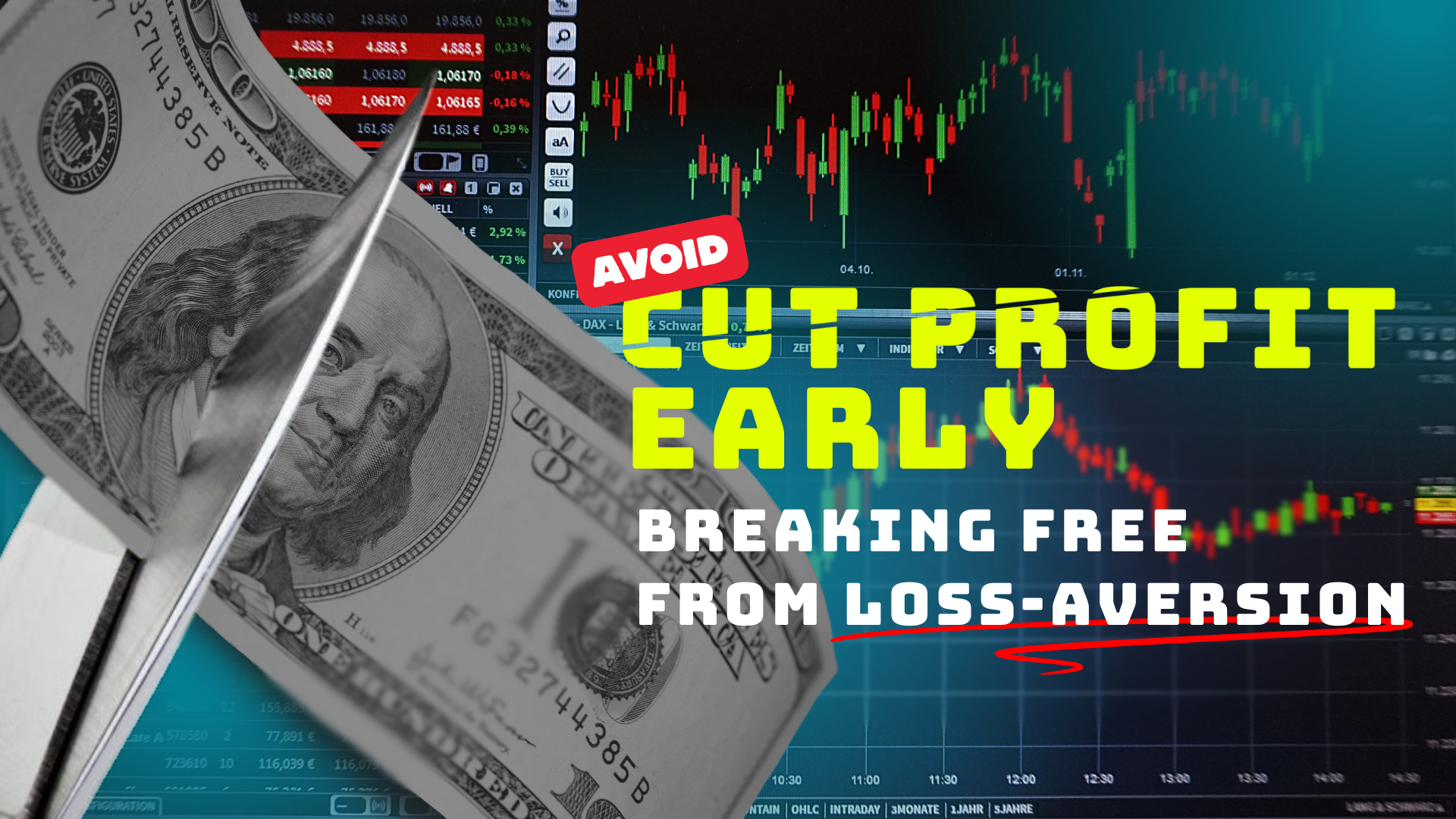
Have you ever found yourself closing a winning trade too early, only to watch it continue to rise after you’ve exited? If so, you’re not alone. Many traders experience the urge to “cut profits early,” a behavior driven by the fear of losing unrealized gains.
While it might seem like a cautious move, this tendency can actually be detrimental to long-term trading success. In this article, we’ll explore why cutting profits early is not a good strategy, the psychological biases behind it, and how you can overcome this common pitfall to maximize your trading potential.
The Financial Impact of Cutting Profits Early
When traders close a trade too early, they often miss out on the full potential profit that could have been realized if they had allowed the trade to reach the predefined Take Profit (TP) level. By exiting early, traders secure only a portion of the possible gains, potentially leaving substantial profits on the table. For example, consider a trader who exits a position with a 5% profit, fearing a market reversal, when the TP level was set at 15%. By closing trade early, they’ve missed out on an additional 10% gain. Over time, these missed opportunities can accumulate, leading to a significantly lower overall return on investment and a less effective trading strategy.

A successful trading strategy relies on maintaining a favorable Reward-Risk Ratio (or a high win rate). When traders consistently cutting profits early, they reduce the reward side of this equation while still exposing themselves to the full extent of losses. This imbalance can result in a negative overall performance, where even a few large losses can wipe out the gains from several smaller profitable trades. Ultimately, this approach can undermine the trader’s ability to grow their account and achieve sustainable success.
The Psychology Behind Cutting Profits Early
The behavior of cutting profits early is often driven by psychological biases, particularly loss aversion. Loss aversion is a well-documented phenomenon in behavioral finance and is a core element of Prospect Theory, a groundbreaking theory developed by Nobel Prize winners Daniel Kahneman and Amos Tversky. Their research suggests that people experience the pain of losses much more acutely—about 2.5 to 3 times more—than the pleasure of equivalent gains. In trading, this psychological tendency often leads traders to prematurely close profitable trades, fearing the possibility of those profits turning into losses more than the pleasure from additional gains in that trade.

However, this behavior can be counterproductive. By cutting profits early, traders may miss out on the full potential of favorable trades. Meanwhile, trades that are left to run when they are at a loss can lead to significantly greater losses. This creates a skewed risk-reward scenario where the strategy keeps profits small and losses large—hardly a formula for long-term success.
How TradeMedic™ Algorithms Help Traders
Recognizing this common behavior, TradeMedic™ has developed sophisticated algorithms to help traders overcome the tendency to cut profits early. These algorithms simulate trades that were manually closed in profit, analyzing what the outcome would have been if the trade had been left open to hit the original TP or Stop Loss (SL) levels.
By disregarding the manual close and simulating potential outcomes, the algorithms detect if the trader would have been better off not closing the trade early. This difference in performance is classified as “cut profits early,” providing traders with actionable insights into their decision-making processes.

For example, the algorithm might show that if a trade had been left open for just a few more hours, the profit would have increased by 20%, highlighting the cost of premature closure. In the TradeMedic™ report, the net effect of those simulated trades is shown. In case the trader would have been better off not cutting those profitable trades early, it’s flagged as an improvement potential.

Analysis and Detection Markers
To detect instances of cutting profits early, the TradeMedic™ algorithms focus on trades that were manually closed while still in profit. For these trades, the algorithms simulate how the trade would have performed over the following few hours if it had not been manually closed. If the simulated outcome suggests a better performance than the actual outcome, it’s clear evidence that the trader cut profits early to their detriment.
Risk and Broader Implications
Understanding the risk associated with cutting profits early is crucial for any trader looking to improve their strategy. This behavior, rooted in the fear of losing unrealized gains, can significantly limit profitability over time. Traders need to recognize that while it might feel safer to lock in profits prematurely, this strategy can prevent them from achieving the full potential of their successful trades.
Mitigation Strategies
To mitigate the negative effects of this behavior, traders can employ several strategies:
- Acknowledge Behavioral Biases: Gaining an understanding of the psychological biases that drive this behavior, such as loss aversion, can help traders become more mindful of their decision-making processes. Being aware of these biases is the first step toward overcoming them.
- Set and Track Reward-to-Risk Ratios: Traders should establish clear Reward-to-Risk Ratios for both their trade setups and their actual trades. This helps maintain a disciplined approach to trading and prevents premature exits. By focusing on these ratios, traders can better evaluate whether a trade should be closed or left to run.
- Employ alternative ways to de-risk trades: Instead of fully closing a position, the trader can use other strategies to reduce the risk of trades, for example my moving the SL to break-even or only partially closing the trade. Thereby, traders keep the upside to the trade, and it may help emotionally to more “secure” in a trade.
- Develop Clear Trade Rules: Establishing rules for trade setups and exits can help improve consistency and reduce the emotional impact of trading decisions, enhancing overall performance. For instance, setting predefined TP and SL levels and sticking to them can help traders avoid making impulsive decisions based on short-term market movements.
By implementing these strategies and leveraging tools like TradeMedic™ algorithms, traders can improve their decision-making processes, avoid the trap of cutting profits early, and ultimately enhance their trading performance.
Cutting profits early is a common but avoidable mistake in trading. By understanding the psychological roots of this behavior and utilizing advanced tools and strategies, traders can avoid this pitfall and allow their successful trades to reach their full potential. With a more disciplined approach, traders stand a better chance of achieving consistent and sustainable success in the markets. So, the next time you feel the urge to cut a profit early, take a step back, review your strategy, and act based on rationally derived principles instead of bias-based value of losses vs. gains.
Ready to approach your trading with more rationality? Connect your trading account with Hoc-trade for free today and experience the power of AI-driven assistance in managing your emotions and optimizing your trades.
👉🏻 Sign up now for free at hoc-trade.com


Leave a Reply